
How to check seller add-backs before you buy a business
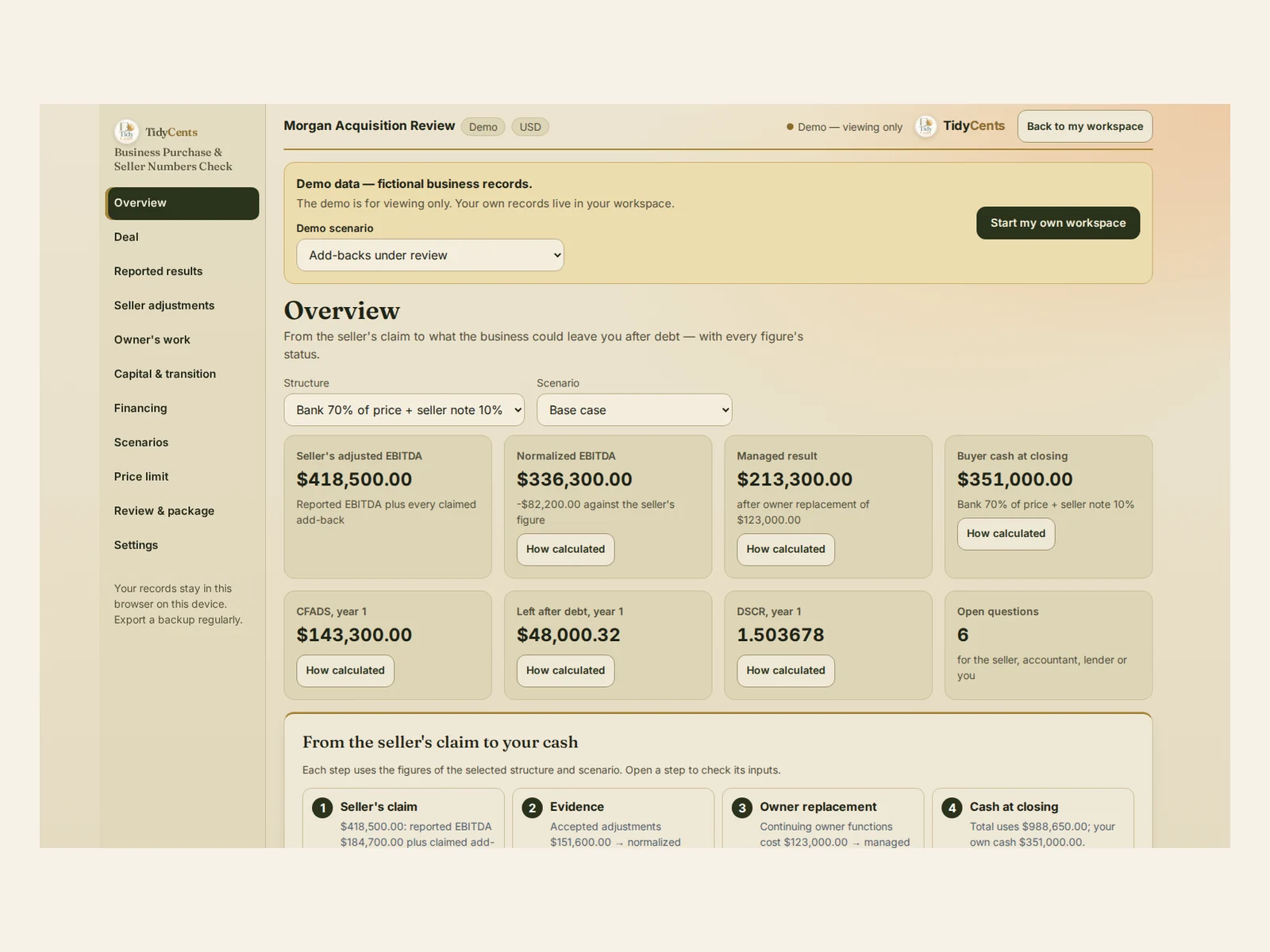
To check seller add-backs, start from the reported result, then accept, partly accept or reject each add-back on its evidence; count pending, rejected and double-counted items as zero; and subtract what it will cost to pay someone for the work the owner does today. Only then test the price: the cash you need at closing and what the business leaves after debt service. In the example below, a seller's figure of $418,500 becomes $336,300 after the evidence review and $213,300 after paying for the owner's work.
Why the seller's number is a starting claim
Add-backs are adjustments the seller says will not continue under a new owner. Some are real, some are not:
- The owner's salary is added back, but the work stays. Someone has to do it, and that costs money.
- One-time costs may repeat. A "one-time" repair that appears every year is an operating cost.
- Items get counted twice. The same expense can hide in two add-backs.
- Family payroll needs evidence. Without documents, it cannot be counted.
- Related-party terms change. Rent paid to the seller may go up or down after the sale.
The formula
- Normalized EBITDA = reported EBITDA + add-backs you accepted (pending, rejected and double-counted ones count as zero).
- Managed result = normalized EBITDA − the cost of replacing the owner's continuing work.
- Cash at closing = price + fees + working-capital shortfall + transition costs + your reserve − loans and other sources.
- CFADS (cash flow available for debt service) = managed result − maintenance capital spending − increase in working capital − cash taxes.
- DSCR = CFADS ÷ debt service; cash after debt = CFADS − debt service.
A worked example
The numbers come from the demo of Business Purchase & Seller Numbers Check: a fictional company with reported EBITDA of $184,700 and $233,800 of claimed add-backs, so the seller presents $418,500.
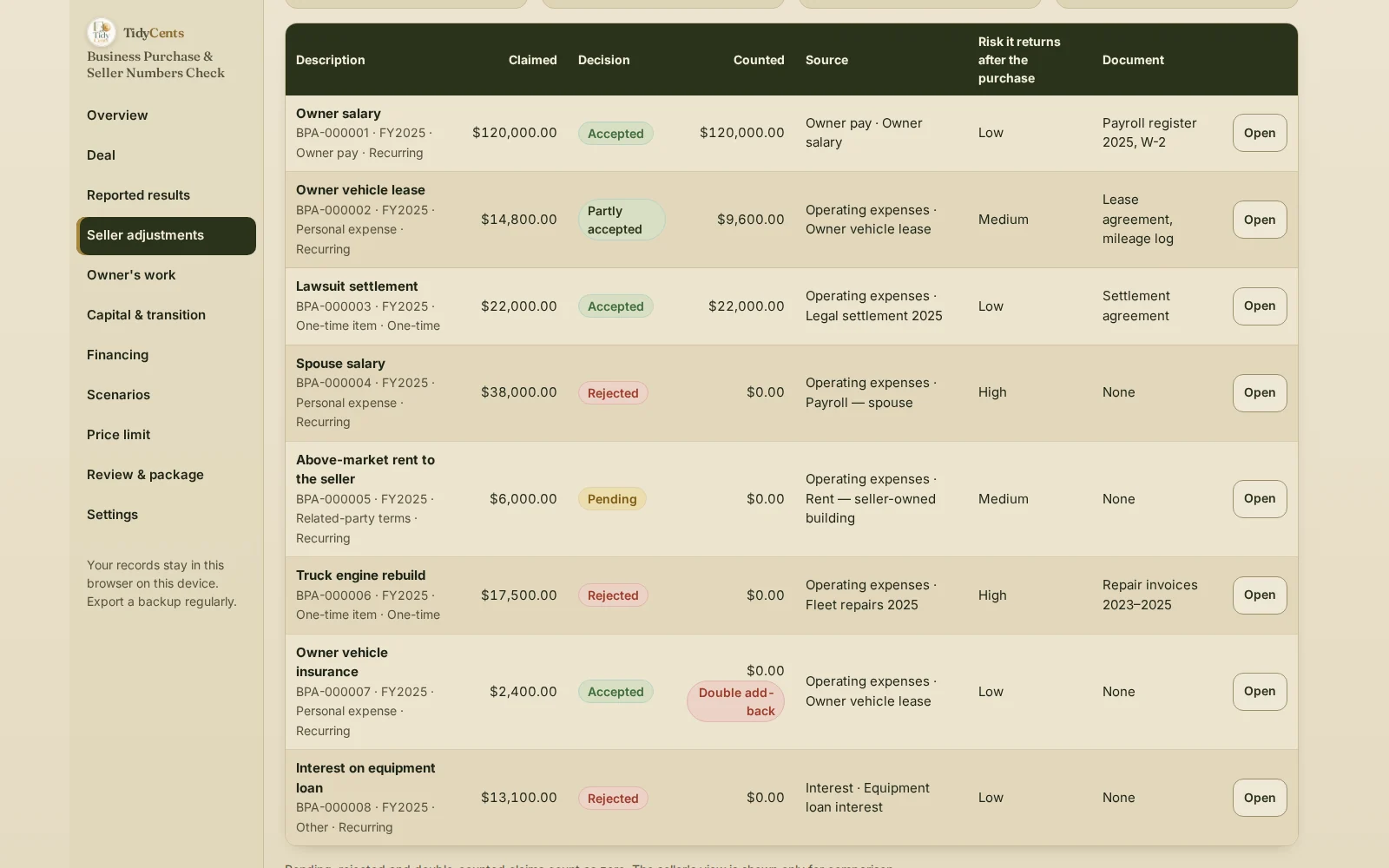
| Add-back | Claimed | Decision | Counted |
|---|---|---|---|
| Owner salary | $120,000 | Accepted | $120,000 |
| Owner vehicle lease | $14,800 | Partly accepted | $9,600 |
| Lawsuit settlement | $22,000 | Accepted | $22,000 |
| Spouse salary | $38,000 | Rejected | $0 |
| Above-market rent to the seller | $6,000 | Pending | $0 |
| Truck engine rebuild | $17,500 | Rejected | $0 |
| Owner vehicle insurance | $2,400 | Double add-back | $0 |
| Interest on equipment loan | $13,100 | Rejected | $0 |
Accepted add-backs total $151,600, so normalized EBITDA is $184,700 + $151,600 = $336,300, which is $82,200 below the seller's figure. The vehicle insurance was already inside the vehicle lease line, and interest is already outside EBITDA, so neither can be added again.
The owner's continuing functions would cost $123,000 to replace, so the managed result is $213,300. With the demo's financing — a bank loan for 70% of the price and a seller note for 10% — the buyer needs $351,000 of own cash at closing. In year 1, CFADS is $143,300, cash left after debt is $48,000.32 and DSCR is 1.503678. The review leaves 6 open questions for the seller, the accountant or the lender.
A simpler check of closing cash and debt cover. Take a $300,000 asset purchase with $10,000 of fees, $20,000 of working capital the business needs, and a $10,000 reserve: uses are $340,000. A bank loan of $70,000 and a seller note of $130,000 cover $200,000, so you bring $140,000. In year 1, EBITDA of $150,000 less $60,000 for a general manager, $10,000 of maintenance spending and $5,000 more working capital, with cash taxes set to zero, gives CFADS of $75,000. To keep the arithmetic visible, the bank loan is repaid over 12 months at 0% interest and the seller note starts after 12 months, so year-1 debt service is $70,000: $5,000 left and a DSCR of 1.07. Any drop of more than $5,000 in yearly cash flow would leave nothing for you.
Step by step: check the seller's numbers
- Enter the reported results by period and name the starting metric: net income, EBIT, EBITDA or operating cash flow.
- List every add-back with the seller's statement and the document behind it.
- Decide each one: accept, accept in part or reject, with a reason; leave unproven items pending.
- Look for double counting between add-backs and in the bridge to EBITDA.
- Price the owner's work: every function that continues needs a salary or your own time.
- Add closing needs: fees, working capital, transition costs, investments and your reserve.
- Compare financing structures on cash at closing, debt service, DSCR and lowest cash.
- Test weaker scenarios, such as lower sales or a lost customer, and export the open questions.
Common mistakes
- Accepting the seller's adjusted figure as income. It is a claim until the evidence is checked.
- Adding back the owner's salary without replacing the work. Your own labour is not free.
- Counting one expense twice. Check where each add-back comes from.
- Ignoring working capital. A business that needs stock and receivables needs cash at closing.
- Leaving out maintenance spending. Equipment wears out whoever owns it.
- Judging the price only on a multiple. Check the cash you need and the debt cover in a weak year.
When a tool helps
A spreadsheet can add up add-backs. It rarely records a decision and its evidence for each one, catches double counting, separates the managed result from your own labour, balances sources and uses at closing and compares financing structures on the same model. Business Purchase & Seller Numbers Check does, and every figure opens to its inputs and formula. It is a planning and evidence-review tool, not a formal valuation, lender approval, legal due diligence or investment recommendation. Exact decimal arithmetic, no AI guesses. To compare loan offers and refinancing, see Business Debt & Refinance Lab.
Open the demo with the review above — every screen, no sign-up — then enter the seller's numbers you received.
Related guides: should I refinance business debt, how much revenue from one client is too much and how to stress test your cash flow.
FAQ
What are seller add-backs?
Expenses the seller adds back to profit because, they say, a new owner would not have them — for example the owner's salary, personal expenses or one-time costs. Each one needs evidence before you count it.
How do I verify an add-back?
Ask for the document behind it — payroll records, a lease, an invoice or an agreement — and check whether the cost really stops after the sale. In the example, $151,600 of $233,800 claimed add-backs could be counted.
Why subtract a replacement cost after adding back the owner's salary?
Because the work continues. In the example, replacing the owner's continuing functions costs $123,000, which turns $336,300 of normalized EBITDA into a managed result of $213,300.
What DSCR do I need?
That depends on your lender and your own margin for a bad year. Calculate it on cash flow after the owner's replacement, maintenance spending and working capital — in the simple example it is 1.07, which leaves $5,000 a year.
This is decision support, not legal, tax or investment advice, and not a valuation.
Tools mentioned in this guide
 Interactive tool
Business Purchase & Seller Numbers Check
Check the seller's earnings adjustments, the cash needed at closing and what the business could leave you after debt.

