
Profit per dish on delivery apps vs dine-in
Profit per dish on a delivery app is the price the customer pays, minus the tax inside it, any promotion and refunds, the app's commission, the food on the plate, the kitchen labour and the packaging. Because the commission is a share of the whole price, a dish usually earns far less through an app than in the dining room — even when the app price is higher. In the example below, a classic burger leaves $7.58 per plate dine-in at $13.90, but only $3.53 on a delivery app at $15.90. The grill that cooks it is also the kitchen's bottleneck, so every delivery burger uses grill time that could earn more elsewhere.
Why delivery profit is hard to see
Sales reports show revenue by channel. What each plate leaves is hidden:
- The commission comes off the top. A 25% fee plus a fixed charge per order is taken from the full price, tax included.
- Promotions run on the app's terms. A 10% offer reduces the price the commission is based on, but not your food or labour.
- Refunds hit delivery harder. Missing items and late orders come back as refunds.
- Packaging is a delivery cost. Containers, bags and sauces cost more than a plate you wash.
- Tax is inside the menu price. With 8% included, part of every sale is not yours.
- Kitchen time is limited. A dish that ties up the busiest station can cost you other sales.
The formula
- Net price = menu price × (1 − promotion) ÷ (1 + tax rate), when tax is included in the price.
- Revenue kept = net price × (1 − refund share).
- Fees = card or app percentage × price + fixed fee per order.
- Food cost per portion = recipe quantities × cost per usable unit (after trim and yield), plus waste.
- Contribution per portion = revenue kept − fees − food − labour − packaging.
- Contribution per station minute = contribution ÷ minutes the dish uses on the busiest station.
- Price to keep the contribution after a cost rise = the price at which the new contribution equals the old one.
A worked example
The numbers are the demo of Menu Profit Planner: a fictional kitchen with five dishes, prices with 8% tax included, a 2.5% card fee in the dining room and for takeaway, and a delivery app charging 25% plus $0.30 an order. Kitchen labour is costed at $18 an hour.
One dish, three channels. The classic burger:
| Dine-in | Takeaway | Delivery app | |
|---|---|---|---|
| Menu price | $13.90 | $13.90 | $15.90, with a 10% promotion |
| Net of tax (and refunds) | $12.87 | $12.87 | $12.85 |
| Card or app fees | $0.35 | $0.35 | $3.88 |
| Food | $3.13 | $3.10 | $3.10 |
| Labour | $1.82 | $1.80 | $1.80 |
| Packaging | — | $0.35 | $0.55 |
| Contribution per portion | $7.58 | $7.28 | $3.53 |
The app price is $2 higher, yet the burger leaves less than half. The same pattern holds across the menu: the chicken rice bowl leaves $7.94 dine-in at $14.50 and $5.08 on the app at $16.90; pasta $8.23 against $5.92; the garden salad $7.12 against $5.20.
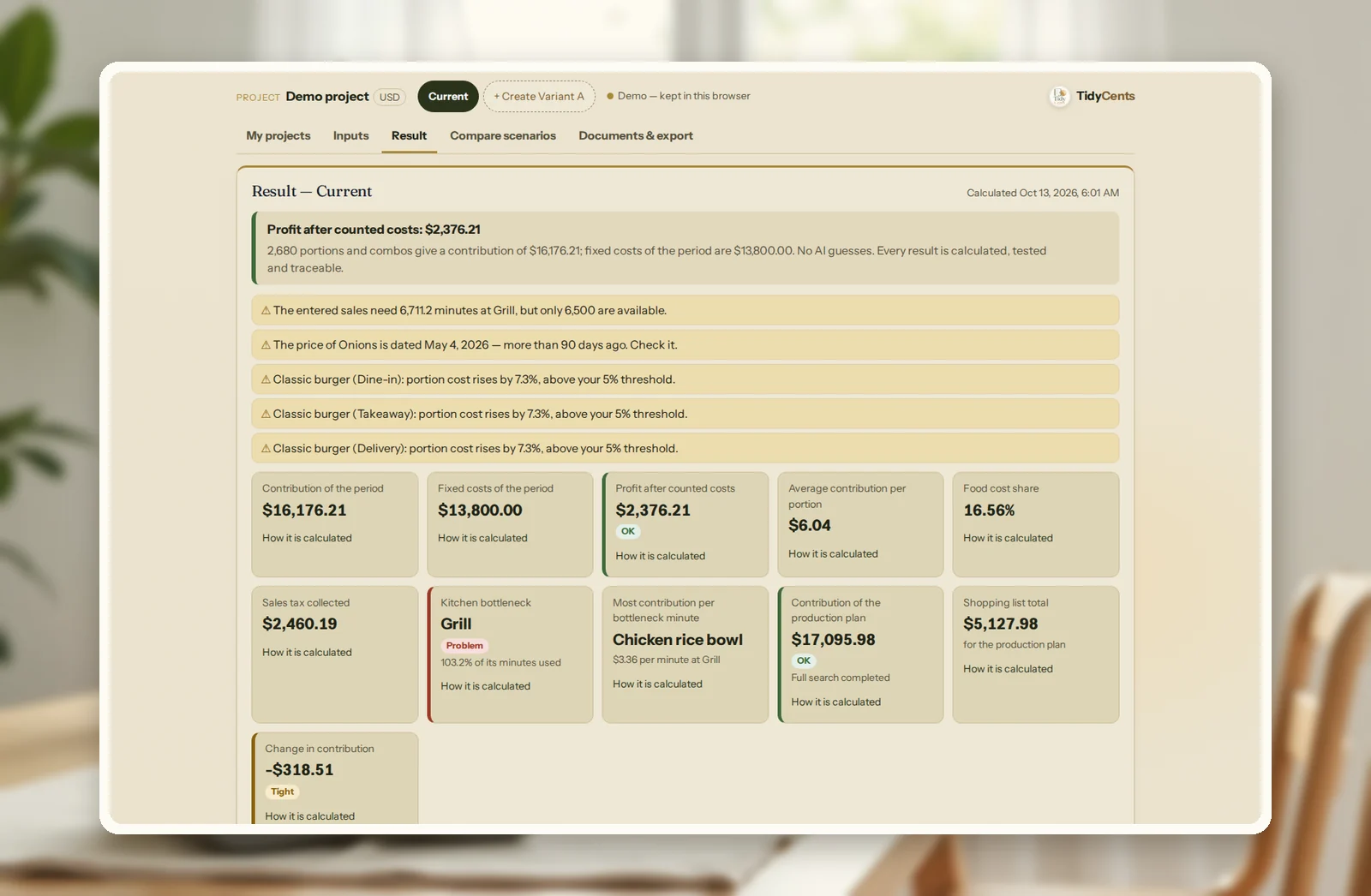
The month. 2,560 plates plus 120 combo deals bring $33,424.90 in sales with tax. After $2,460.19 of tax, $3,353.73 of fees, $5,093.05 of food (a 16.6% food cost), $5,600.85 of labour and $528.50 of packaging, the menu contributes $16,176.21. Fixed costs of $13,800 leave $2,376.21.
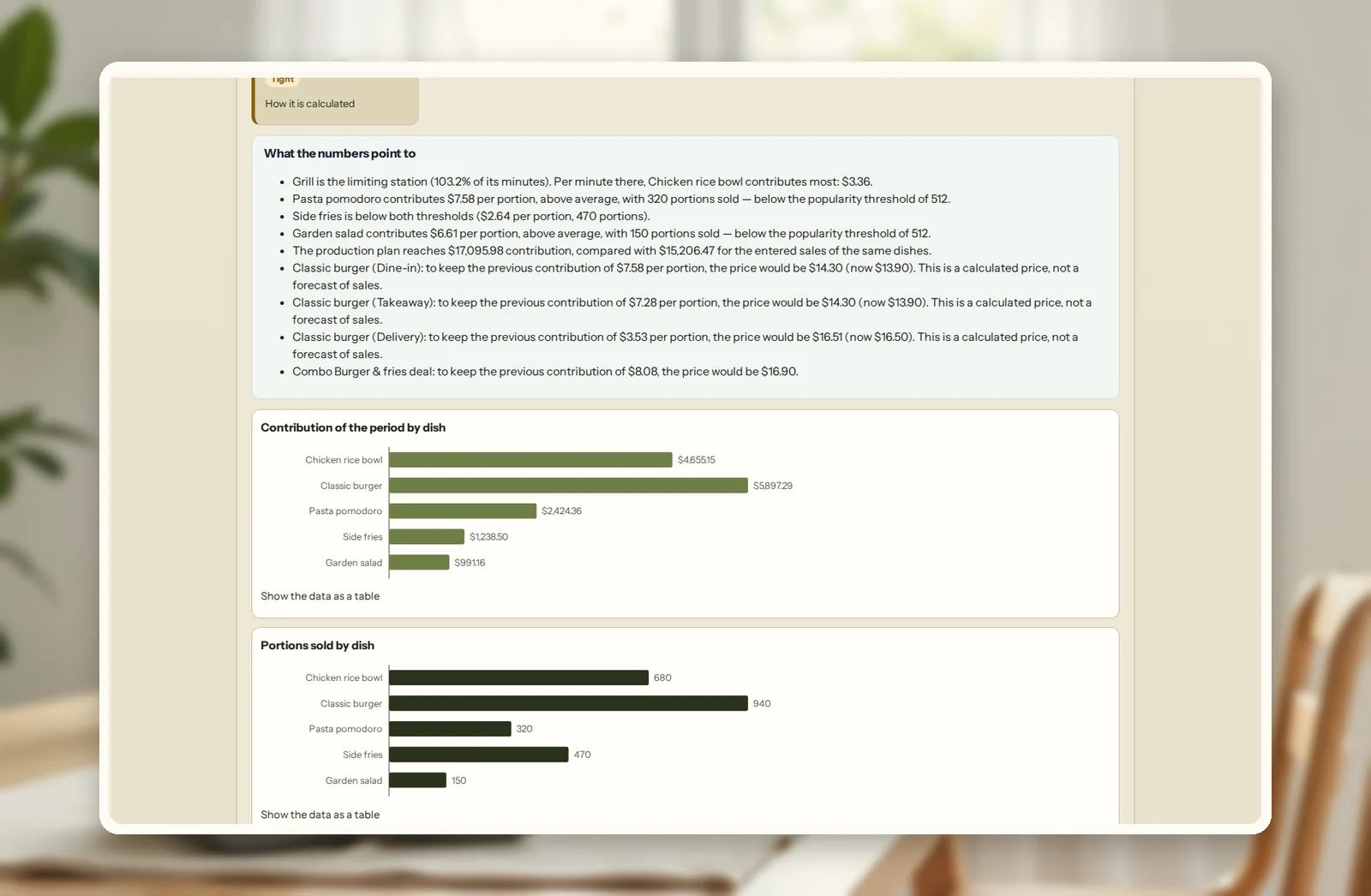
The bottleneck. The menu needs 6,711.2 grill minutes in a month with 6,500 available — 103%. Per grill minute, the chicken bowl contributes $3.36 on average; the burger, which needs 5 grill minutes, earns $1.50 a minute dine-in and $0.71 on the app.
A better mix. Within the owner's demand limits and the grill's capacity, the tool's production plan reaches $17,095.98 of contribution for these dishes, against $15,206.47 for the current sales. The biggest change: delivery burgers drop from 290 to 76 a month, and the grill time goes to dishes and channels that earn more per minute.
When beef goes up. If a 5 lb pack of beef rises from $27.50 to $32, the burger's food and labour cost per portion rises 7.3%. Dine-in contribution falls from $7.58 to $7.22; keeping it would take a price of $14.30 instead of $13.90. On the app, the owner tested $16.50 with sales falling from 290 to 270: each burger still leaves about $3.52, but the month's total falls from $1,023.23 to $951.24.
Combos. A takeaway burger-and-fries deal at $16.50 — against $18.40 for the two separately — leaves $8.08 per deal.
Step by step: price dishes by channel
- Enter ingredients with pack price, pack size and usable yield after trimming.
- Build each recipe, including sub-recipes such as sauces, with portions and prep minutes.
- Enter prices by channel, with tax, card or app fees, promotions, refunds and packaging.
- Read contribution per portion for each dish in each channel, not just food cost percentage.
- Add station minutes and capacity, and find the station that limits the kitchen.
- Compare contribution per minute on that station before pushing a dish.
- Test price, portion and cost changes before you reprint the menu.
- Set channel prices and promotions so that delivery orders still leave enough.
Common mistakes
- Judging dishes by food cost percentage alone. A low food cost can hide high labour or fees.
- Using the same price everywhere. App fees often need a higher app price — and that may still not be enough.
- Accepting app promotions without the numbers. Check what each discounted order leaves.
- Forgetting packaging and refunds. They are small per order and large per month.
- Ignoring the busiest station. More orders do not help if the grill is already full.
- Waiting for supplier price rises to show up in the month's results. Recalculate when the invoice changes.
When a tool helps
A spreadsheet can cost a recipe. It rarely handles trim yields, unit conversions, sub-recipes, tax-inclusive prices, card and app fees, promotions, refunds, packaging, station capacity, ingredient limits and an optimal production plan in one place. Menu Profit Planner does, and also prints a shopping list and a menu-engineering view. Exact decimal arithmetic, no AI guesses. For products sold online rather than plates, see Marketplace Profit & Price.
Open the demo with the five dishes above — every screen, no sign-up — then enter your own menu and channels.
Related guides: real profit per marketplace order, how to calculate a reorder point and are my ads profitable.
FAQ
Is food delivery profitable for restaurants?
It can be, but each plate usually leaves less than in the dining room because the app's commission is taken from the full price. In the example, a burger leaves $7.58 dine-in and $3.53 on the app, even with a $2 higher app price.
How much should I raise prices on delivery apps?
Enough that each order still leaves the contribution you need after the commission, promotions, refunds and packaging. Calculate it per dish rather than adding the same percentage to every item.
What is a good food cost percentage?
There is no single right number. Food cost percentage ignores labour, fees and packaging, so compare dishes by contribution per portion and per minute of your busiest station instead.
How do I know which dishes to push?
Look at contribution per portion and popularity together, and at contribution per minute on the station that limits your kitchen. In the example, the chicken bowl earns $3.36 per grill minute on average, against $0.71 for a delivery burger.
What should I do when an ingredient price rises?
Recalculate the affected dishes and see the price that keeps their contribution. In the example, a beef price rise means $14.30 instead of $13.90 to keep the dine-in burger's contribution.
This is decision support, not tax or legal advice.
Tools mentioned in this guide
 Interactive tool
Menu Profit Planner
Find what each dish really earns per channel and per minute of your busiest kitchen station, plan production within your limits, and see what an ingredient price rise does to the whole menu.

